On my first visit to Kabul I met up with the Afghan photographers of AINA Photo Agency.  It was my hope that we could create a collaborative photography exhibit featuring top Western conflict photographers alongside emerging Afghan photojournalists.   We met with all the photographers and looked at their top ten best.  There were a handful of talented photographers with unique viewpoints into their own country.

I was determined to find a way to showcase Afghanistan from a variety of perspectives in order to break stereotypes, tell stories, and connect cultures.   Finding Afghan photographers working to create a living out of their craft in a country that has few outlets for photography, made me acutely aware of the importance of creating an outlet that would give them a voice.   I knew that I wanted to use powerful and stirring images to provoke discussion and use that as a launching off point to share the vision and mission of Mountain 2 Mountain in Afghanistan.  We are working in a country that does not allow for much face to face cultural exchange.

Upon my return, I realized that the hard part was raising sponsorship money for the exhibit.   And how to connect the gallery exhibit to our fundraisers in a format that would involve the participants.

I focused on projects and programs in Afghanistan, fundraising, and the overall organization of our non profit.  Then, a little over a year later, a generous angel sponsor from Colorado Springs feel into our laps, interested in giving breath to the exhibition so that we could take photography beyond galleries and tie it closer to our ethos of connecting communities of cultures.

Views of Afghanistan is a collaborative multimedia exhibition, combing large format photography, video projection, music, and humans themselves, to create a wholly unique and innovative photography experience.  Unlike anything done before in the non profit realm, Mountain 2 Mountain will launch this exhibition with a sneak peek in Denver on April 22 at Suite 200 in downtown Denver, Colorado.

Seven foot high banners will re-create Kabul’s city streets and Afghan rural roads to create walkways that visitors can ‘walk through’.  Interspersed throughout are both still and video portraits that introduce female teachers, members of parliament, doctors, streetchildren, prisoners, and students as living, breathing individuals, each with a unique story of life in Afghanistan for women. Additional 10 foot by 6 foot images preside as larger than life photography.

Audio speakers play recorded sounds down the ‘streets’ and women dressed in burqas wander aimlessly throughout the crowds.  Hundreds of Afghan kites creates canopies of color and symbolize the hope of the Afghan people.

All of this creates the experience for an educational, interactive, and immersion style fundraising event that connects our supporters, donors, and community members closer than ever possible to our projects and communities in Afghanistan.

Our unique collection of Western and Afghan photographers includes; Seamus Murphy, a VII photographer, is arguably one of the top photographers of Afghanistan in the world.  Travis Beard is a conflict photographer having lived and worked in Afghanistan since 2001.  Beth Wald shoots for National Geographic and has spent extensive time in remote regions of Afghanistan with nomadic tribes.  Tony Di Zinno is an international sports photographer and adjunct professor at the prestigious Art Center College of Design.   Five Afghan photographers represent their country burgeoning talent behind the lens, Wakil Kohsar, Mariam Alimi, Gulbulddin, Najibullah Mustafer, and Farzana Wahidy.

Asking price:  $20,000

Sunday, January 3rd.  The start of the New Year finds me reading a heartbreaking, but not uncommon, story of a young Afghan woman who has been put on the auction block for $20,000.   Just one of the estimated 80% of Afghan women that are forced into marriages, her story is not uncommon, but her circumstances are unique and worth sharing as a reminder that these woman are worth advocating for.

This girl was lucky to be part of a growing number of Afghan girls that are encouraged by their fathers to get an education.   Unique enough when men not only tolerate, but encourage their daughters to become educated.  More unique still, when fathers refuse or postpone marriage proposals for their daughters in order for their education to be completed.

In this particular case, the father died and the girl’s care fell to the eldest brothers.  They viewed her value as little more than dollar signs and set up her engagement to distant relative for $20,000.  This uncle lives in a Taliban-held province that would mean requiring her to wear the burqa, abandon further education, stay in the home, and give up any dreams of a career other than a mother to a large family.

The likely outcome?  She’ll be sold as the ‘happy bride’, or she will choose the route of many young girls and take her own life in an effort to excise some control over her own fate and avoid a life condemned.   Either way its a tragic ending to a woman who was born with the support of her father to follow her dreams.

As tragic as this story is, it solidifies our efforts with Mountain 2 Mountain to help empower Afghan women and children.  To help girls have access to education, and to ensure that the men in their families and communities understand how much more valuable their female counterparts are when educated and employed.   Building schools is just one step.   Scholarships, community support, vocational training, advocacy, and microfinance are all part of the cycle towards empowerment, opportunity, and equality.

Stories like “I am for Sale” about the young women above and others written by Afghan women telling their stories can be found at The Afghan Women’s Writing Project:  http://awwproject.wordpress.com/

Mountain 2 Mountain was founded on mountain sport and culture.  Literally the organization was founded with the idea of creating a trail race in the mountains of Breckenridge as a fundraiser three years ago. Overnight that idea blossomed into a full blown non profit working in the mountains of Central Asia.   Yet the idea of mountain sport and culture remains as a way to tap into the energy mountain folk have and use that energy to fundraise.  Specifically harness the energy of climbers, bikers, runners, and skiers to help support our projects in Afghanistan.

This year alone, Mountain 2 Mountain started a mountain biking team, Team M2M, in which members raised money for projects and rode in the team jersey at races to spread awareness.  We hosted the 2nd annual Race for the Mountains trail race here in Breckenridge, raising enough money to sponsor a computer lab.  Mountain 2 Mountain was also recipient of both the Breck 100 bike race, and the 2nd annual Climb for Literacy.   Thane Wright, director of the Breck 100 generously donated $1000 by pledging a percentage of race entries to our cause.  Ellen Miller and Larry Moore of Vail, Colorado co-created the Climb for Literacy last year to support literacy and education non profits like ours through the energy of competitive climbers.  Climbers got sponsors to pledge a certain amount per vertical foot and then climbed their butts off on the Vail Athletic Club’s indoor climbing wall in a series of sponsored days of climbing with the Vail climbing coaches and supporters cheering them on, raising serious cash for great causes in education like ours.  We hope to take their model and apply it in other climbing communities!

Word spreads beyond the mountains, and its not just mountain lovers that now support our efforts.  Road bikers in New Jersey are sponsoring a ride to support education in Afghanistan.  After discovering that the Taliban had banned all sports, including kiteflying, when they were in power, two girls in North Dakota decide to rally their elementary school to build their own Afghan kites.  They are using the project to help fundraise for building a school with us.  Word spread to another school in New York City and a 4th grade class is set to do the same thing in an effort to sponsor a computer lab.

Photography has also been part of our cultural exchange and ethos from the beginning.  We started with using photography as a backdrop as an author event with Greg Mortenson with photographer, Beth Wald who had travelled with Greg in Afghanistan.  That evolved into our first collaborative photography exhibit, Views of the Himalaya, that stood on its own as a gallery exhibit.  This past year we created an entirely new exhibit with Dreams of Kabul, a photography exhibit based soley on the work of Tony Di Zinno who travelled with founder, Shannon Galpin, on her first visit to Afghanistan.  This exhibit combines the experience of an art show with the purpose of a fundraiser.  Combining culture and outreach in the form of storytelling to connect our communities across the world.

While much of our fundraising comes the old fashioned way with fundraisers, grants, and the generosity of the public at large….its fun and exciting to see individuals and communities do what they love in an effort to support our projects.  So to those of you using your creativity and your muscle power to find unique ways to raise money and awareness for our efforts – we thank you!!

IMG_9663-5


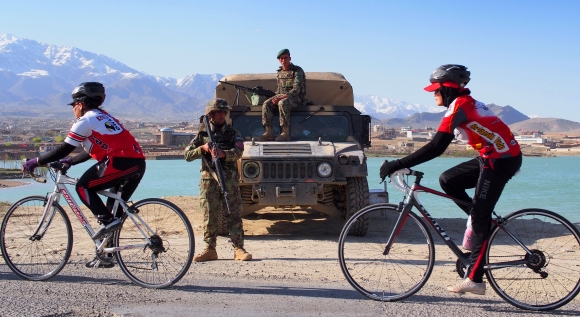
On October 3rd this year, my birthday coincidentally, I became the first woman to mountain bike in Afghanistan.   The irony of accomplishing something like this was that it started out so simply….each trip I’ve spent in Afghanistan I’ve longed for my bike.  The goat trails, the dirt roads, and the incredible mountains scream out to me to get pedalling!

The non profit I founded, Mountain to Mountain, is focused on women and children’s education and empowerment in remote mountain communities, in particularly in Afghanistan.  Yet a large part of our ethos is connecting communities and cultures.  I have come to realize that being the founder of a non profit and a mountain biker is not necessarily mutually exclusive.

So this trip, I made the decision to lug my trusted steed on the arduous journey from Colorado to Kabul.  Mountain to Mountain becoming quite literal as my Niner biked its way through Singlespeed World Championships in Durango, Colorado on a Saturday, only to be packed up, still dirty, to join me on a series of flights to Afghanistan the following week.

It wasn’t intended to be any sort of record creating, being the first at something, kind of excursion.  It’s simply a way for me to do what I do, in a country that I love, and perhaps change a few perceptions about what women can and can’t do in the process.  After some googling and researching, we discovered that no other woman had done this.   Not really surprising as this is Afghanistan we’re talking about.  Women don’t ride bikes here.  Foreign women try to stay relatively low key.  For good reason.  Between the land mines, suicide bombers, the Taliban, and the usual crap against women that exists in many Islamic countries, mountain biking isn’t high on anyone’s (male or female) priority list.

I decided to ride my bike in two provinces of Afghanistan, which happen to be two of the provinces that Mountain to Mountain is working in…connecting our mission with our ethos.  Education and cultural exchange.  Couple that with my desire to break barriers and crack open the long held stereotypes that pigeon hole women in many regions of the world, it was a no brainer.  The long term vision being that this trip I challenge perceptions and stereotypes on both sides of the coin.

Westerners assume Afghan men won’t accept women on bikes, because no women do it.   Truth, many won’t and don’t.  But the majority we encountered not only tolerated it, but chatted with us, joked and supported it.

Afghans expect that Westerners are too scared and too closed off to come out of their NGO and military compounds to interact with them and their country.  Westerners (including many that live and work in Afghanistan) assume you’ll be shot dead or kidnapped the moment you leave the confines of your secure car or compound.  I try to do my errands on my own whenever possible via walking or motorbike. I walk in the markets, stay in residential neighborhoods, and often conduct my daily errands alone so that I can take the time to connect with shopkeepers and security guards.  I buy my naan bread from a local baker round the block, have learned where to buy fresh yogurt measured out into a plastic bag and sold by the weight.

Mountain biking is just another extension of that desire to interact with Afghans more fully by doing what comes naturally.

Now this is not to say, it is without danger, or that all men would tolerate this.  There are men, especially in other, more conservative provinces, that wouldn’t.  I am fully aware of security concerns and am not ignorant of the risks I take by exposing myself on a bike.  I chose and discussed my location choices carefully.  Baby steps were taken on remote mountain paths and dirt roads before riding my bike through a village.  There are still areas of this country where I couldn’t step out of my car without a burqa on.   Areas where foreigners of either sex, are at risk, simply by trying to do their work.   Assassinations and kidnappings still occur and foreigners are not trusted.  But there are areas where genuine human interaction and cultural exchange are not only possible but desired.

Yet as I’ve said many times before, if no one ever does it, it will never change.  Its my own version of:  ”Just because that’s the way things are, doesn’t mean its the way they should be.”

photo by Travis Beard

PA091988

Third visit with the Afghanistan National Deaf Association (ANAD) and the school they are running in Kabul.  Not much has changed.  This project may be the most difficult to accomplish – but potentially the most rewarding.

We have been working to acquire land, twice having it fall through or be deemed unacceptable.  The deaf have very few advocates in Afghanistan.  10,000 deaf are estimated, and there are three small schools operating that service close to 1,000.  All three working privately, with donors and partnering with NGO’s to keep running without any governmental support.

This lack of support is frustrating for all concerned, but depressingly highlighted during a visit with representatives of ANAD with current Afghan President, Hamid Karzai a month ago.  The representatives of ANAD are deaf, and as such attended the meeting with a signing translator and a Dari interpreter.  The purpose was to get permission on a parcel of government owned land in Kabul on which to build a school for the deaf.  At an early stage in the meeting, Karzai asked his aide, what are those people doing with their hands?   When it was explained that they were deaf, and that this is how they communicate, he started crying (he is quite emotionally at times like these) and expressing his surprise and shame that he didn’t know there were deaf in Afghanistan.  Shocking and yet, not surprising.

So a parcel of land was offered at a greatly reduced cost for the deaf school.  Paperwork was drawn up, but until money exchanges hands, or the land is built upon, there is the worry that this could be given away to someone else at the drop of a hat.

When I went back to visit ANAD and discuss next steps, the blueprints and paperwork was proudly shown and we piled into a minivan to make the long, bumpy, and dusty ride out to an area of Kabul I’d never seen.  The area is vast and empty, a proverbial desert in the middle of a bustling city.  The land is a large parcel, and would allow for the school, teacher training building, and a small guesthouse.  The main road is on the city’s master plan to be fully paved which would shorten the commute greatly.   We walked the land and discussed possibilities, but the main issue being the land cost.  We are fundraising here to raise money for the school and staff, but the land cost is a hefty curveball.

Despite the continued hard work to secure land, this is a project that is desperately needed.  As Karzai, himself, illustrated, Afghanistan is unaware of its own deaf community.  In fact, I’d venture to say, that there isn’t a deaf community.  Not really.  Not like we see in other countries.  The deaf here are living in silence, with its own government unaware of its very existence.  There is little advocacy for this population, and virtually none outside Kabul and Jalalabad.  The steps forward are more difficult that building schools for girls, women at risk, or teacher training programs.  More difficult even than working in the women’s prisons.  This group cannot communicate without the aid of translators, and there are a handful in the country.  More schools can’t be built until more teachers are found and trained.  The three small schools that are taking students, are working towards communication, not a complete education.  There are gaping holes that need to be filled, and it will take an enormous amount of support, funding, and partnering with the deaf communities outside of Afghanistan to mentor them into developing a viable and thriving community within its borders.   A focus on communication, literacy, and vocation skills are needed immediately while a more comprehensive curriculum can be developed over time and with qualified teachers.

Until then, these children will continue to live in silence.

This story is taken from another blogsite - Dry Mouth – Kabul Life. http://drymouth.tumblr.com/

It is an inspiring example of brave Afghan women taking on leadership roles, carving out a life for themselves and their families, and how occasionally they are lucky enough to be doing so with the support of their husbands.  Unusual?  Yes.  But definitely the story we should be striving to spread as we work to gain more support to create opportunity and education for amazing women like Lisa Nooristani.  If this doesn’t warm your heart and make you pull out your wallet to support more women like this, I don’t know what will.  Help Mountain to Mountain make a difference with women like this in remote areas of Afghanistan, so that women can continue to take on these roles of business and leadership and change the perception of women as smart, economically important, and deserving of respect.  It starts with education and microfinance – all of which is simpler than one would think.  To learn more about how to get involved – visit www.mountain2mountain.org

—–

During the week in which we had arranged an interview, Lisa Nooristani, CEO of Mutaharek Construction Company, received a death threat letter from the Taliban. It warned her not to continue in her successful construction building and absolutely not to appear on any media. Nonetheless I am publishing a photograph of her face and will shortly be producing a short video piece on her as part of a series on Afghan Businesswomen. Why? Because she insisted. I asked her several times if she would like to call off the interview and told her that any film I took would be broadcast not only all over the web and potentially picked up by major broadcasters like CNN and Sky, but also likely be picked up by Afghan media.

I met her at the gates of the US military run Provincial Reconstruction Team base in Nurestan. She had wanted to drive through the gates in her car, but as their scanner was down, the gate guards wouldn’t let her so she stomped up the steep hill to meet me smiling as she huffed and puffed. I later learned she had recently had a C-section to deliver her sixth child.

We had a pre-interview chat with a local interpreter providing the bridge that her sparse English and my even sparser Dari lacked. Open-faced with features that at once were younger and older than her 28 years, her voice was quiet and her eyes fixed on mine with a firm kindness.

“I have visited countries like Iran and Pakistan. I even went to America. I saw how these countries are, how they’re developed, how women are developed. And I was happy because I saw how we are all human. But then I was sad because I didn’t know why my country couldn’t be like that. Why is my country destroyed?”

“Those threat letters I received, they obviously upset me because these people are my people, they’re not Iranian or Pakistanian, they’re Afghan. They’re my brothers and I still respect them. But I’m not afraid of their threatening letters.”

She added, “If they kill me, then at least my children will be proud of me”.

She was married at 14 and told me how she didn’t stop crying all day. A couple of days later, sitting in her home, surrounded by her children, I looked at photos of her wedding day. Her young face caked in make-up, she was the only one not smiling.

Yet, her marriage has been successful. Her husband supports her completely and tells her he regards her as his ‘brother’. As un-romantic as this may sound to western ears, to an Afghan woman, this is a high compliment. Lisa laughs as she tells me how people talk about her husband, saying ‘he isn’t a man. He allows his wife to talk with foreigners. Look! She talks with them, she sits with them’. She smiles as she says, ‘he doesn’t listen to this kind of talk. He knows his wife is working for her homeland’.

I can’t emphasise enough how inspiring this sweet, kind and determined woman is. And how brave she is for talking to me. ‘I want to improve the condition of Nurestani women’, she says several times during the interview. She tells me how bad conditions are for these women: how they’re not allowed to even wash without asking their husband for a piece of soap; how they’re expected to keep on working even while they’re giving birth; how they deliver babies in the middle of the forest while gathering wood, cutting the umbilical cord with a blunt chopping knife.

“I just want support. Not only for me but for all women and especially Nurestani women.”

PA032004

Our driver, Shah Mohammed is thrilled to to see me again…big smile. Unfortuantely, its soon very apparently that he should not be driving outside the city, in fact, probably shouldn’t be driving as a profession AT ALL. Hamid, my flatmate and translator, sits next to him in the front and it was soon apparent that Shah Mohammed couldn’t see the numerous speed bumps. The ancient Toyota Corolla is not meant to take on these things at high speed, yet Shah Mohommad couldn’t see them till it was too late. It came to a head, so to speak, just around the corner from Massoud’s Tomb in the Panjshir – rounded a bend, the car was suddenly careening towards the cliff and the cement/rock barriers that border the road. Luckily these barriers are solid, we broke a huge chunk away and thus slowed the car down enough to stop before following the rocks tumbling down the cliff side. In typical Afghan style, Shah Mohommad quickly reverses to drive off. We shout for him to stop and check the car, the barrier, and collect ourselves. It was truly inches from death and it was interesting to have that near death experience and realize that your life doesn’t flash before your eyes…you just internally think, “well, damn”.

The ironic part is that Toyota Corollas are resilient as hell. Proof in point, take out a concrete barrier, get a crowbar out to pull the fender and the wheel panel back into place and we’re off. No harm no foul. Other than the kid that came running down the street to tell us we needed to pay for the barrier.

Clouds were rolling in hard and we headed to ‘our village’.  We continue a couple more hours down a pretty rough mountain road.  Each time Shah Mohammad turns sharply to the left, the wheel grinding in the crushed wheel, every time he braked, the wheels squealing. It was around this time that our near-sighted driver starts bitching. He wasn’t happy he had to drive so far, on such bad roads, etc. etc. Hamid took the brunt of it. About 15 minutes from the village, Shah Mohammad actually tells Hamid he wouldn’t go any further. It turned into a bit of kerfuffle and I said I wasn’t paying if he turned around. We said we had hired him for the day to go to Panjshir, if he had a problem with how far, or the roads, etc. he should have said and we would have hired another driver.  He continues to complain but keeps driving.

Travis and Hamid found this village a while back while journeying through this area.  They had randomly stopped to ask if they knew of somewhere they could stay and Idi Mohammad immediately offered his home.  Turns out he is the principal of the village school and Travis told him about me and the work I was looking to do with Mountain to Mountain.  They returned a second time a few weeks later  and again stayed with Idi Mohammad’s family.

As we pull up, the village looks the same as any of the other villages we’ve driven through. The only distinguishing feature is its remoteness and the new building of mud being built on the left side of the road. A two story building with two men on the roof. One is Idi Mohammad, in a Panshiri hat (the type favored by Massoud). Turns out that this is to be a guesthouse, and his family’s home is directly behind. He was all smiles when he saw Travis and Hamid.  He comes down from the roof while we walk around back, gathering a crowd of children and men behind us.  I am introduced and find myself, once again, mesmerized by the handsome features of Panjshiri men. Idi Mohammad is genuinely happy to see the guys and asks how their motorbike trip went, he was worried about them.

Hamid explains that we wanted to stop by so that they could introduce me, but that we have to go back tonight, especially as our driver is being such a pain in the ass.  Idi Mohammad looks concerned and unhappy that we cannot stay the night. He offers a second time, and we explain that our driver is the main issue, but that we will be back next week and will stay longer.   We take a seat on a stone wall overlooking the road and the valley.  It turns out that he was originally a teacher, and spent many years as a Pakastani refugee. When he returned to his village he started up a school with a couple other teachers to teach the children. It expanded and they now have a school that services all the way through high school. He is the principal and while they have a school, and teachers, they are lacking in supplies. This is something I can help with this trip. We discussed the need for stationary (paper and pens) is the biggest need. Ironically it’s the reason many children do not attend school. Their families are simply too poor to afford the 20 cents for a notebook. The school houses 600 students on average. Amazingly, the other need is computers. I was surprised, and asked why they felt computers would be a necessary component of their school.  Idi Mohammad explained that it connects them to the rest of the world and allows their remote village to provide better education for their children. They already have a teacher qualified in computer sciences so its simply a matter of machines.

I also ask Idi Mohammad about neighboring villages that don’t have schools. Would he be able to direct me to others that are lacking schools entirely. He agrees to come up with a list before my next visit.  He also mentions that up on the mountain behind the village is a small community of fifty families. Their children make the long walk to attend the school at ‘our village’, but that the young ones (grade 1-5) are unable to attend school during the winter due to the snow. They are simply too young to make that walk. We discussed building a primary school there so that they can attend their classes year round and stay with the same coursework as the larger school and when they are old enough they will graduate into ‘our village’ school to finish through high school. It would be a simple project , a few classrooms only. We talk briefly about construction and logistics and Idi Mohammad looks at me with all seriousness and says that if necessary he will oversee the construction himself. We have ourselves a school, a computer lab, and a project manager. As well as a solid contact for reaching out and making first steps in other villages.

During the last few minutes of the talk, a loud repetitive banging is heard, I look behind us to the street to see Shah Mohammed banging away at the front fender with a crowbar. Passive aggressive behavior or does he really think it will fix the wheel?

Dark was coming on, our driver had a crowbar he was starting to use more agressively, and our tummies were rumbling.  Perhaps it was time to make the four hour drive back home.   We said our goodbyes with the promise we’d return to stay for several days next week to discuss further.

Great leaps forward.  Good stuff.

DSC04320

Yesterday I enjoyed the pleasure of delivering six laptops for a girls school in Kabul.  I also paid for a new generator and the salary for a computer teacher for one year.   Just under $3,000 set up a computer lab and funded it for one year.  In a country like Afghanistan where schools and teachers themselves are sorely lacking, should it be a priority to delve into computer labs and training?

The agreement to set up a computer lab at a girls secondary school was born out of the desire to help, and out of curiosity.  Would the computers, especially ones not hooked up to the internet, be of genuine use? $3,000 could pay yearly salaries for two teachers at the school.  There were questions to be answered debating the use of funds for computers over teachers or more traditional curriculumn.

Then I met the girls.

6 laptops were brought over from the States.   The box arrived safely in Kabul airport only to be delayed by the security guards checking our baggage via x-ray as we left the baggage claim.  Mind you, its already been screened at least four or five times since leaving Denver, have paid two tariffs for extra baggage and weight charges and they have the cheek to try to get me to pay a bribe for bringing in the laptops for the girls school.  A dialogue over the fact that these were intended to be DONATED not sold to a girls school, etc. etc. went back and forth for a while.   Luckily, I had duct taped that box up so good that when they keep shouting at me to open and I shouted back… “WITH WHAT?” as I clearly couldn’t open without a knife or scissors.  They finally shooed me out of there.

Next up was arranging for delivery.  My good friend, photographer, and Afghan advisor in this country, Travis Beard, took on the additional role of chauffeur and tied the box onto the back of his motorbike, so that the computers, both of us, and his video equipment all squeezed onto the Japanese dirt bike for the 30 minute drive to the school.

We arrived safely and gathered the seventh year girls in the room designated to be used as the computer lab.  We asked them how many had used computers before, twelve raised their hands, and we discovered that they had all shared one computer a couple of years back.  We asked what many of them wanted to do after school.  The answers ranged from: artists, teachers, journalists, tailors, doctors, and even one policewoman.  Amazing girls with lofty dreams.

How would the computers help them reach their goal?  The girls all reiterated that the main benefits of computers were how they made the world a smaller place.  Knowledge was more accessible, word and excel programming made their work more efficient, and internet broadened the world beyond Afghanistan.

All but the artists raised their hands when we asked if they felt computers would be necessary for their future work.

Then we turned it around, the girls got ask me questions.  One girl asked the all important question, “why us?”  ”Why did you decide to help the girls of Afghanistan?”   Its a tougher answer than you’d think.  How do you put to words the deep seated anger and frustration one feels over the inequity and struggle women and girls suffer every day in Afghanistan?   How do you explain that you can’t NOT help if at all possible to make their worth come to light?  In the end, I simply said, “I have a daughter.  Devon is five years old and you deserve to have the same education and opportunities that she does.” That said it all.

The girls continued to ask questions shyly and eventually  we unpacked the laptops so the girls be part of the set up of the lab.  We said our goodbyes and one of the girls raised her hand to speak, “Thank you for the computers and for saying that we are as important as your daughter.”   These girls are amazing and I felt humbled by their gratitude.  They  are getting nothing less than what they deserve, the right to an education and the tools to make their lofty careers goals a reality.

Ironically it is the same case in a much different school.  A co-ed school in the remote mountains of Panjshir.  A village several hours down the valley that has a school from 1st-12th year.   Very unusual in a village this remote.  I spoke at length with the principal and one of the founding teachers of the school about what the school needs and he discussed the need for stationary (paper and pens) at their school is the biggest need.  Surprisingly, it’s the reason many children do not attend school.  Their families are simply too poor to afford the 20 cents for a notebook.   The school houses 600 students on average.

Amazingly, the other need is computers.  I was surprised, and asked why they felt computers would be a necessary component of their school.  IM explained that it connects them to the rest of the world and allows their remote village to provide better education for their children.  They already have a teacher qualified in computer sciences so its simply a matter of machines.

As a great friend and mentor has told me numerous times, “Go over there and listen.  Have cups of tea and listen.”  Well, I’m listening and I am getting the message.

_G0X7763

As leaves start to turn a pale shade of yellow, children across our nation return to school, and thoughts turn towards crisp autumn days, we find ourselves preparing for another trip to Afghanistan at a time where they are experiencing a different change of season.  The election season has come and gone, but votes are still be counted, accusations of corruption fly from all sides, and a nation struggles to retain the hope that the season ahead is brighter than that left behind.

Today Karzai and Abdullah Abdullah are in a dead heat, pardon the phrase.  A run-off appears likely.  I spoke today on WDAY radio in North Dakota and the host, Christopher Gabriel asked me the question, “What will the election result mean for Mountain to Mountain?”  In the best case, very little will change and small changes will continue to move things forward in terms of education, development, and opportunity.  In the worst, the public loses hope and confidence in its government and those that would exploit that apathy step in to fill the gap with violence and oppression.

Mountain to Mountain believes that regardless of the electoral outcome – our way ahead is firmly set in place.  As we revisit Afghanistan this autumn it is only fitting that we implement our first independent projects at the same change of season that first brought us to this country.   This trip sees us setting up a computer lab at a girls secondary school.   We plan to interview the teachers and students and revisit them yearly to watch their progress and track the relevance of computer training for their education and career paths.

This trip is also focused on taking the next step with several larger projects we are fundraising for.   The first is with the deaf school in Kabul.   Securing land, discussing the teacher training program, and school requirements.  The second is to visit several communities in the mountains to discuss potential sites for schools in the region.  We look forward to meeting with community elders and discovering how we can best work together to bring education to the children in these villages.

At the same time – our own organization is changing as we say goodbye to the first half of the year’s efforts to get balls rolling, set structure, and discover how to work together effectively as a Board.  As autumn comes, we find ourselves starting to see some of the fruits of our labor ready to harvest.  Our 2nd Annual Race for the Mountain trail running event raised over $3,000 towards a computer lab.  Team M2M launched in July and its handful of initial members have raised over $3,000 in just two short months.   The Dreams of Kabul photography exhibit launches its opening night fundraising in September as its first stop on a traveling tour of galleries.  Communities across the nation are developing their own fundraising initiatives and events to help us build schools, educate girls, and empower young women to find their way in the world.

As we move forward into the next season we hope that we can continue to build upon the events we’ve set in motion in the season’s past to create opportunity in the seasons yet to come!

photo by Di Zinno

Despite Karzai’s last minute pull out from the televised debates between the top three candidate – he is still presumed the front runner in the upcoming Afghan presidential elections.   Tolo TV held the debates and Karzai claimed that his last minute refusal to take part was due to the debates exclusion of all the presidential candidates.    Yet with a whopping 41 candidates are taking part, it was hardly sensible.  It would take the entire program just to get the introductions out of the way!  And so Abdullah Abdullah and Ashraf Ghani debated the failed Afghan policies on either side of an empty podium to highlight Karzai’s absence.  

http://english.aljazeera.net/news/asia/2009/07/200972319351993992.html

Meanwhile, Karzai’s controversial running mate, Mohammed Qasim Fahim’s convoy was attacked in Kunduz province.  Not exactly unexpected with the rise in random roadside violence and scare tactics leading up to the election, but the location of the attack is surprising.  The north has been seeing an upsurge in roadside attacks disrupting its relative peacefulness and safety.   Kunduz especially has seen an upswing as the Taliban work to disrupt foreign supply routes, and attempt to scare voters away from the polls.  

Luckily no one in the convoy was killed, and amazingly only a cameraman travelling in the group was injured.  Ethnically Tajik, Fahim helps to diversify Karzai’s Pashtun ticket by representing the two largest ethnic groups.  While he fought with the Northern Alliance to oust the Taliban in 2001, Fahim has been tagged by the Human Rights Watch for his sordid history of murder and corruption throughout the last 30 years of war.   

Aside from the violence upswing, this is an exciting time to be in Afghanistan.  Several friends are heading over (mostly photojournalists) to cover the events and I’m jealous of their front row ticket to the impending changeover.   While Karzai may very well win a second term despite his inability to stem the Taliban resurgence since his election in 2001, Abdullah and Ghani are giving him a run for his money.  Focusing on failed policies and broad charges of corruption, there is a chance of change as long as voters are allowed to cast their ballots.  

Why should we, as Westerners care which direction Afghanistan goes?  Many reasons.  Beyond my personal love of this country and its resilient citizens, is the international communities investment of money and lives in an attempt to provide security for this country to develop as an independent and free country.  Our focus with Mountain to Mountain is education, knowing that an educated society can best make the choices needed for a country to grow and flourish.  Education levels the playing field between ethnicity, class and gender, ensuring that all citizens have a voice.  Education creates a space for dialogue and debate without weapons but instead with ideas.  An educated society can set its own course, in a way that protects and ensures the rights of ALL of its citizens.

I return after the elections to take on the next steps in our own small efforts in this changing region.  We will set up a computer lab at a girls secondary school in Kabul in order to study the benefits of computer education and computer literacy in furthering the education of girls continuing on to high school and college.  We will also make the next steps in tackling our larger projects in building schools and bringing education to women’s prisons.  As the country continues to move forward, so do we.

Enter your email address to subscribe to this blog and receive notifications of new posts by email.

Twitter Updates

Pages